
Fully glued parquet has many advantages
Particularly quiet, stable and durable
Thanks to the simpler, floating installation of modern parquet planks with a click system, the full-area gluing of a parquet floor is often no longer considered today. Yet the glued installation method offers tangible advantages.
Why glue down parquet?
The biggest advantage is the unrivalled quietness. Gluing the flooring firmly to the subfloor reduces room noise and impact sound to an absolute minimum - without any additional impact sound insulation. In addition, fully bonded parquet works less and can therefore be laid over larger areas without separating rails. This is also an advantage when laying over underfloor heating or cooling. In addition, heat transfer is significantly more efficient with glued parquet flooring, especially when using 2-layer parquet. And you don't have to worry about renovation, as parquet can be sanded several times, depending on the series. The best way to restore an older wooden floor to its former beauty and freshness.
Laying and gluing strip parquet professionally
So-called 2-layer parquet - or strip parquet - must always be glued down. However, this is also possible for every variant of our HARO 3-layer parquet flooring instead of floating installation.
Full-surface gluing of the finished parquet requires attention to many details: from the professional inspection and preparation of the subfloor to the selection and use of the correct adhesive and any necessary measures in the room, primers or levelling compounds, right through to the extremely accurate laying of the parquet elements. After all, once an element has been laid and glued down, it is not so easy to remove and adjust it afterwards. For this reason, full-surface bonding of parquet flooring, as opposed to floating installation, is generally the task of a competent and qualified professional.
However, ambitious DIY enthusiasts with experience in laying engineered parquet can of course lay and glue down your floor themselves. You can find valuable tips here:
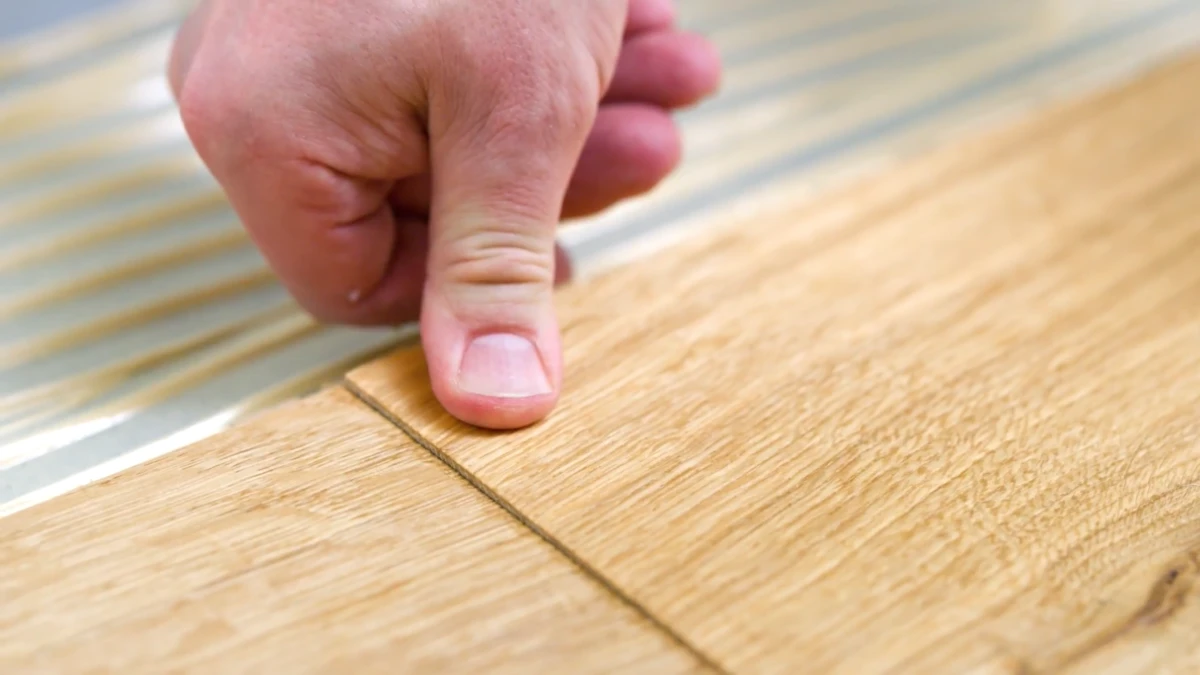
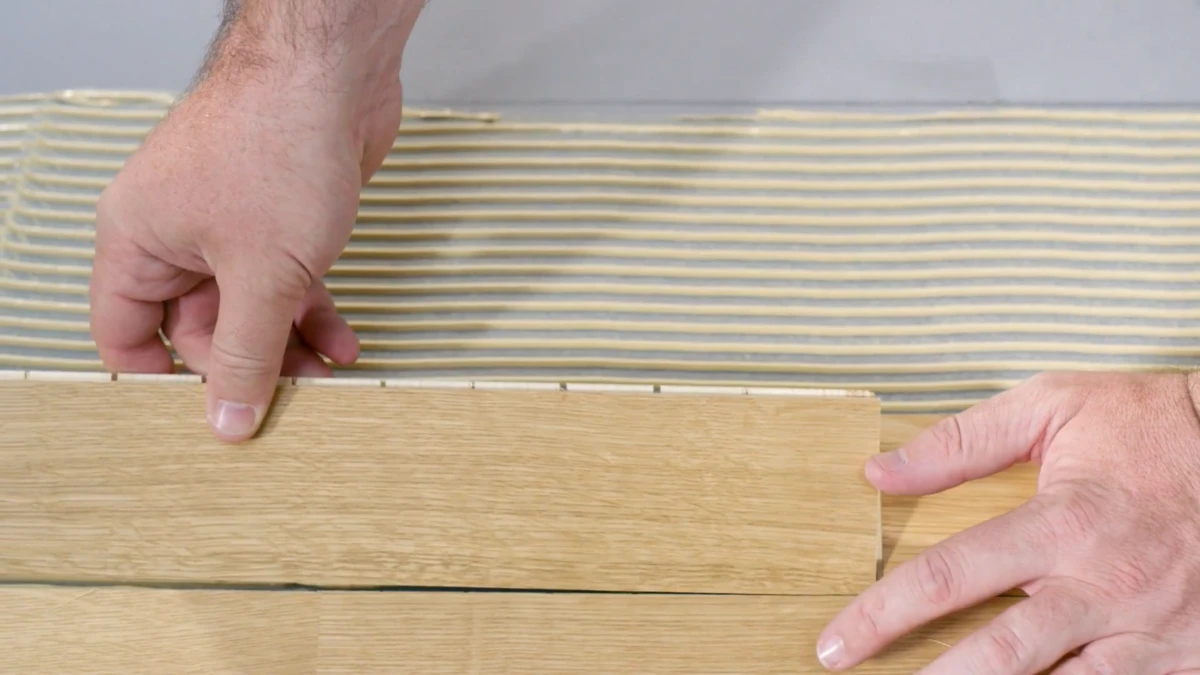
Flooring made easy with the tongue and groove plus system
With the innovative HARO tongue and groove plus system for 2-layer parquet, flooring professionals benefit from the advantages of a practical insertion aid:
- Place the tongue side on the special groove cheek
- Push into the groove
- Tongue does not lie in the adhesive bed
- Adhesive is not pushed between tongue and groove
- No fitting problems
- Adhesive does not reach the surface
- No removal of adhesive residues necessary

Do I need an expansion joint when gluing parquet?
With fully bonded wooden floors, it is generally not necessary to install transition, end or adjustment profiles as expansion joints. For acoustic reasons, an expansion gap only needs to be maintained between solid components and walls. This distance usually results in an expansion joint of approx. 10 mm between the wall and the first row of parquet (depending on the edge joint in the substructure), or a few millimetres for other components or adjacent solid floor coverings (e.g. tiles). At the end of installation, this expansion joint is sealed with colour-matching acrylic, for example. If there are expansion joints in the substructure, these should also be taken into account during installation. As the subfloor "works" at this point, there is a high probability that the parquet will shift in the long term. In this case, seek advice from a professional installer on how the expansion joint should be transferred to the bonded wood flooring.

Particularly in the hallway with its special geometry and the many room connections, full-surface bonding can make sense.
Do you need impact sound insulation when gluing down parquet?
In contrast to floating installation, no additional impact sound insulation is generally required for full-surface gluing. If required - for example in extremely noisy buildings - Silent Double Fix impact sound insulation (approved for gluing) can be used.
HARO Accessories for gluing parquet over the entire surface
Do you need a vapour barrier when gluing parquet?
It is not possible to install a vapour barrier when gluing down parquet flooring over the entire surface. However, a vapour barrier is generally mandatory when laying wood floating on a mineral subfloor such as screed.
Before laying your parquet flooring, please be sure to observe the information on the readiness for covering of your subfloor (measurement of residual moisture)
Effective patterns
Strip parquet can be laid in numerous different patterns. From the classic "herringbone" to the lively "wild pattern" - be inspired by the variety of laying patterns and discover exactly the design variant that perfectly suits your rooms and your individual living style.

Soothing warmth
The noblest and most beautiful way of laying engineered parquet, full-surface gluing, is also possible on underfloor heating and cooling. It is even particularly efficient in terms of heat transfer - not least because there is no footfall sound insulation. Find out all about the advantages of glued HARO parquet flooring on underfloor heating.
